
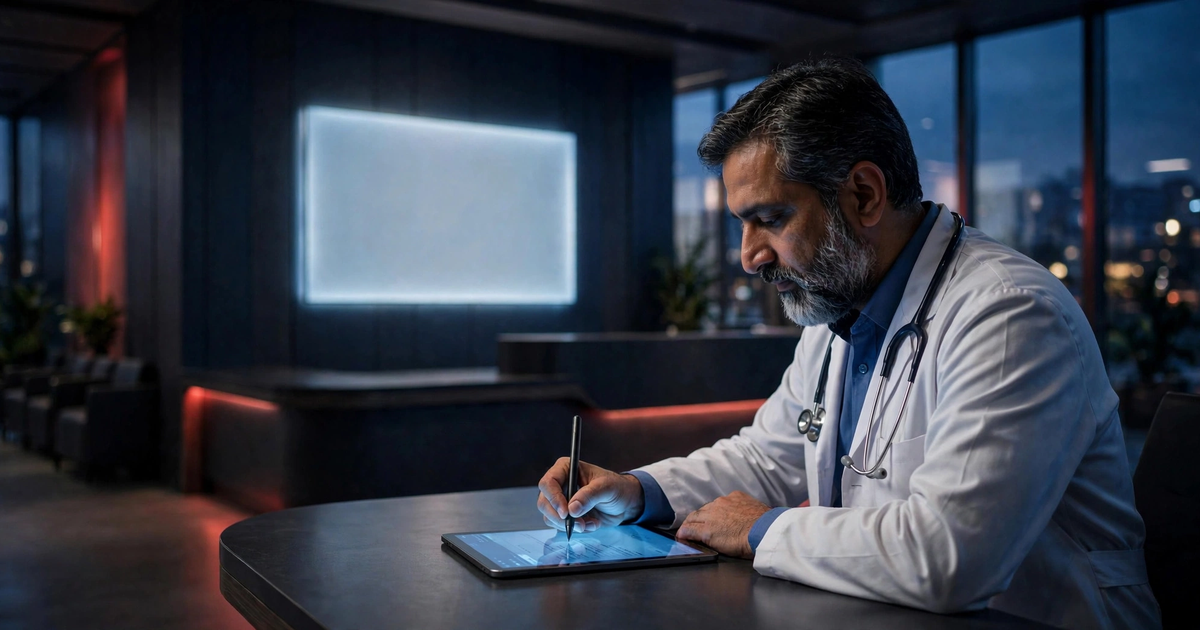
Every Pakistani doctor has heard the joke: "Doctor sahab, your handwriting is so bad even the medical store needs a decoder." It gets a laugh, but behind it sits a real problem. The prescription — the single most important document your clinic produces — is usually a hurried scribble on a small slip that fades within a month, gets lost in a handbag, or gets misread at the pharmacy. When the patient returns next week and the slip is gone, the consultation starts from zero: "Kya dawai di thi? Yaad nahi."
Going paperless with prescriptions does not mean buying expensive hospital software. It means a simple, repeatable workflow: the prescription is typed once, saved to the patient's record, and delivered in a form the patient can actually use — printed, sent on WhatsApp, or both. Here is how clinics like yours make that switch without disrupting the OPD.
Why the paper slip costs more than you think
A handwritten prescription creates four quiet costs. First, lost history: when the patient loses the slip — and most do — you retake the entire history and guess at previous medications. In a 60-patient OPD, two lost minutes per patient add up to hours every week. Second, pharmacy callbacks: the medical store phones your clinic to ask "yeh kya likha hai?" — every call interrupts your staff mid-work. Third, errors: Pakistan's market has dozens of brands for common molecules, and unclear handwriting is how the wrong brand gets dispensed. Fourth, no record: without a copy, you cannot see what you prescribed last time, which makes follow-up visits harder and leaves you exposed if a question ever arises.
None of this is the doctor's fault — it is the medium's fault. A typed prescription fixes all four at once: it is readable, searchable, and automatically becomes part of the patient's file.
Three delivery models — pick what fits your patients
1. Print at the clinic
The simplest upgrade: type the prescription, print it on your letterhead, stamp and sign it. Patients receive something professional that lasts. A basic laser printer costs around Rs 25,000–35,000, and each printout costs a few rupees. Most established clinics start here, and for older patients who do not use smartphones, print remains the best option.
2. WhatsApp / PDF delivery
Type the prescription, save it as a PDF, and send it to the patient's WhatsApp from the clinic's number. Younger, urban patients love this: the prescription can never be lost, it can be forwarded to a family member or a pharmacy, and it sits beside the appointment reminder. The pharmacy receives a clean, zoomable document instead of a blurry photo of a paper slip.
3. The hybrid most clinics settle on
Print for patients who want paper, WhatsApp for everyone else — and always keep the digital copy in the patient's record regardless. The record copy is the point; delivery is just the patient's convenience. Ask once per patient: "Print kar dun ya WhatsApp pe bhej dun?" Within a week it becomes routine.
Templates: where the real time-saving happens
Doctors resist digital prescriptions for one reason: "typing takes longer than writing." That is true on day one and false by day thirty — but only if you use templates. A template is a pre-built prescription skeleton for the conditions you see every day: viral fever, hypertension follow-up, URTI, gastroenteritis, migraine.
A good template contains the diagnosis line, the standard drug list with doses and durations, the standard advice ("aaram karein, pani zyada piyein"), and the follow-up instruction. During the consultation you pick the template, adjust the two or three things that differ for this patient, and you are done — often faster than writing by hand. Build your ten most-used templates first; they will cover 80% of your OPD.
Write instructions in Urdu
Medicine names stay in English — pharmacies need that — but the instructions on how to take the medicine should be in Urdu for most patients: "khane ke baad, subah shaam, 5 din". Patients follow instructions they can read. Clinics that switched to Urdu instructions report noticeably better compliance, especially with elderly patients and those from rural backgrounds.
Keep a clean drug list
Every clinic develops favourite brands. Maintain a shortlist of the 50–100 drugs you actually prescribe, with your preferred brand, strength and standard dose pre-filled. When a medical representative convinces you to switch brands, update the list once instead of re-typing it on every prescription for the next year.
Are digital prescriptions legally valid in Pakistan?
This is the question every doctor asks, and the honest answer is: a prescription's validity comes from the doctor, not the paper. What makes a prescription legitimate is that it is issued by a registered medical practitioner — your PMDC registration number, your name, and your signature or stamp on it.
The practical standard clinics follow: every printed prescription carries the clinic letterhead, your PMDC registration number, and a stamp with a physical or digital signature. For WhatsApp-delivered prescriptions, the same details appear on the PDF. Most importantly, keep a copy of every prescription you issue — digitally, attached to the patient's record. If a question ever arises, whether a pharmacy dispute or a medico-legal matter, a complete, dated, searchable record is far stronger protection than a carbon copy in a register. Good records are also the foundation of sensible follow-up pricing, because you can see exactly what was done last visit.
What about patients who cannot read?
A significant share of patients in Pakistani clinics — particularly elderly patients and those from rural areas — cannot read a prescription in any language. A typed slip does not fix that by itself, so build these habits into your workflow.
Explain out loud, every time. "Yeh subah wali goli hai, yeh raat wali. Khane ke baad leni hai." Thirty seconds of spoken instruction beats the clearest printout. Mark the medicines. Many doctors draw a sun for morning, a moon for night, or simply number the strips with a marker: 1, 2, 3 — matching the verbal explanation. Loop in the attendant. Ask "ghar mein kaun dawai dega?" and direct the explanation — and the WhatsApp copy — to that person. Use voice notes. A 20-second WhatsApp voice note explaining the dosage survives where paper fails, and the family can replay it. These small steps turn a digital prescription from a document into actual compliance.
Mistakes that undo the whole effort
Sending a photo of the computer screen
A blurry photo of a monitor is worse than a paper slip. Always generate a proper PDF — clean, zoomable, printable. It takes one extra click, and it is the difference between "digital" and "actually digital".
No backup of the records
A typed prescription that lives only on one reception computer is one hard-drive failure away from disappearing. Whatever system you use, make sure records back up automatically — this is non-negotiable. Paper registers survived floods; a single PC does not.
Using the doctor's personal WhatsApp
Prescriptions sent from a personal number blur into family chats, get deleted, and expose the doctor's private number to hundreds of patients. Use a dedicated clinic number for all patient communication. It also makes the clinic look like the professional setup it is.
How Clendra helps
Clendra is built around the prescription workflow described above: pick a template, adjust for the patient, and the prescription is saved to the patient's file, printable on your letterhead, and sendable as a clean PDF on WhatsApp — in one flow, with Urdu instructions supported. Every prescription stays linked to the patient's MR number, so next visit's history is one click away, and records back up automatically. See how it works or get early access.
Frequently asked questions
Do I need expensive software to go paperless with prescriptions?
No. The workflow is: type, save, print or send as PDF. A basic computer, a printer and a consistent filing habit get you 90% of the way. Dedicated clinic software simply makes the template and record-keeping parts faster and safer.
Will older patients accept a WhatsApp prescription?
Many will not — and that is fine. The hybrid model exists for exactly this reason: print for those who want paper, WhatsApp for those who prefer it. The digital copy in your records is what matters most.
What should every prescription include?
Patient name and age, date, diagnosis or indication, each drug with strength, dose, frequency and duration, your name, PMDC registration number, clinic contact details, and signature or stamp. Instructions in Urdu dramatically improve compliance.
How do I handle refills without a new visit?
For stable chronic patients — hypertension, diabetes — many clinics re-send the previous prescription as a refill with a review date noted. Keep it documented in the patient's record, and set a firm rule, for example no more than two refills without a check-up, so it stays safe and ethical.
Can a pharmacy refuse a digital prescription?
A clean printed or PDF prescription with your registration number and signature is accepted by pharmacies across Pakistan. Problems only arise with blurry screen photos or prescriptions missing the doctor's details — exactly what a proper digital workflow eliminates.