
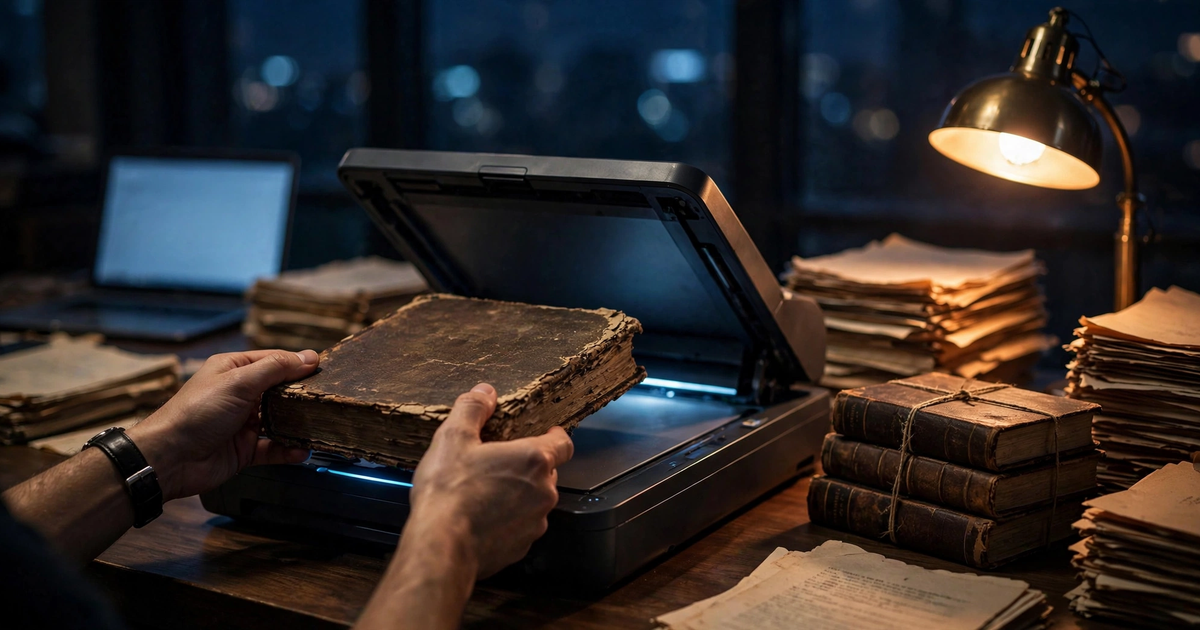
Every established clinic in Pakistan has one: the storeroom with ten years of registers, files stacked to the ceiling, tied with string, slowly yellowing. Nobody dares throw anything away ("kahin zaroorat par jaye"), nobody can find anything in it either, and it quietly occupies a room that could be a consultation chamber earning Rs 2,000 a visit. Going digital does not mean scanning every page since 2015. It means a ruthless, practical plan: scan what matters, summarize what is useful, and let the rest go — legally and safely.
Here is that plan, built for clinics that do not have an IT department.
First, understand what you actually have
Before touching a single file, spend one afternoon surveying the mountain. Most clinic archives contain four kinds of records, and each deserves a different fate: patient files and registers (visit notes, prescriptions, investigation reports); financial records (fee registers, expense books, salary records); administrative records (staff files, supplier bills, rent agreements); and medico-legal records (consent forms, procedure notes, referral letters, anything involving a complication or dispute).
Sort the archive into these piles — literally, with four corners of the room — before deciding anything. The single biggest mistake clinics make is treating all old paper as equally precious. It is not.
The three fates: scan, summarize, discard
Scan: the irreplaceable few
Scan documents you could never recreate and might genuinely need: consent forms, operative and procedure notes, discharge summaries, key investigation reports (biopsies, CT/MRI reports, ECGs with abnormal findings), and any record tied to a complication, dispute or legal notice. A flatbed scanner — Rs 15,000–25,000 — handles these fine. Name each scan clearly: patient name, MR number, date, document type. A folder of 500 scans named "scan001.pdf" is barely better than the storeroom.
Summarize: the long histories
For chronic patients with thick files — the diabetic with six years of visits, the hypertensive with a decade of BP readings — do not scan every page. Write a one-page clinical summary: diagnosis, key investigations with dates, current medications, allergies, major events. This takes five minutes per patient and produces something more useful than the original file, because the next doctor can read it in one minute instead of excavating thirty pages. Prioritize your regular, active chronic patients; their summaries pay for themselves at every visit.
Discard: the expired bulk
Here is the liberating truth: most of the archive can go. Ten-year-old routine OPD entries for one-time viral fevers, long-settled supplier bills, expired staff attendance registers — these have no clinical, financial or legal value left. Discarding does not mean the raddi wala: medical records contain personal health information, so shred or burn them. A small shredder costs a few thousand rupees and is worth it for patient confidentiality alone.
Prioritize ruthlessly: the 3-box method
You will never digitize everything, so decide the order deliberately. Box 1 — this month: records of active patients seen in the last year, plus anything medico-legally sensitive. Box 2 — this quarter: chronic-patient summaries and the last 2–3 years of financial records (tax and audit relevance). Box 3 — when time allows: everything older, handled opportunistically — when a Box 3 patient returns, their file gets scanned or summarized then and there.
The golden rule: from today forward, everything new is digital. The archive is a shrinking problem; new paper is a growing one. Stop the growth first — our paperless prescription workflow and MR numbering guide cover the two highest-impact starting points.
How long must you keep medical records?
This is the question that keeps the storeroom full. The conservative, widely followed guidance for Pakistani private clinics: keep clinical records for at least 3 years from the last visit for adults, and for minors, until several years after they reach adulthood. Records involving procedures, anesthesia, complications or any dispute should be kept much longer — many clinics keep these indefinitely, and digital storage makes "indefinitely" essentially free.
Financial records follow tax logic: keep them for at least 6 years to satisfy FBR audit requirements. The practical upshot: routine OPD notes older than a few years with no ongoing relevance are safe to summarize-and-discard, while procedure records, consent forms and anything disputed stay — scanned and backed up.
A note of caution: these are general guidelines, not legal advice. If your specialty carries higher litigation risk — surgery, obstetrics, anesthesia — keep longer and consult your professional association's guidance.
Storage: where the scans actually live
Scans sitting on one reception PC are not "digitized" — they are one theft, fire or hard-drive crash away from vanishing. Follow the simple version of the backup rule: three copies, two places. The working copy on the clinic computer, an automatic backup to an external drive kept off-site (the doctor's home is fine), and a cloud copy. Cloud storage for a clinic's scans costs a few hundred rupees a month — trivial next to the value of the records.
Organize with a folder structure that mirrors how you think: by year, then by MR number, or simply by patient. Whatever you choose, write it down as a one-page filing policy and tape it near the computer. The system only survives if anyone can follow it, including the new receptionist.
Mistakes that waste the whole effort
Scanning everything
The clinic that tries to scan ten years of registers page by page burns out in week two and abandons the project. Scan the irreplaceable, summarize the useful, discard the rest. Selectivity is the entire strategy.
Scanning without naming
Unnamed scans are a digital storeroom — same mess, new medium. Name every file at scan time: it takes ten seconds then and ten minutes later.
Letting new paper pile up during the project
Digitizing the archive while today's OPD still runs on paper registers is mopping with the tap open. Fix the incoming flow first, then work the backlog.
How Clendra helps
Clendra gives every patient a digital file from day one — visits, prescriptions, investigations and consent forms filed under one MR number, with automatic cloud backup so the "one PC dies" scenario cannot happen. Old summaries can be entered as the patient's baseline history, so the archive project ends with a genuinely usable record, not just scans. See how it works or get early access.
Frequently asked questions
Do I really need to keep 10-year-old OPD registers?
Almost certainly not in full. Summarize what has ongoing clinical value (chronic patients' histories), scan anything medico-legally sensitive, and securely discard routine one-visit entries older than a few years. The room they occupy is worth more than the paper.
What is the cheapest way to start scanning?
A basic flatbed scanner (Rs 15,000–25,000) and a disciplined file-naming habit. For bound registers you cannot cut apart, a phone scanning app works surprisingly well — just keep the naming discipline.
Is a scanned copy legally as good as the original?
For practical clinic purposes, a clear, complete, well-organized scan made in the ordinary course of business is strong evidence. Keep originals of anything currently disputed or likely to be, and when in doubt, keep the original of procedure-related documents.
How do I dispose of old medical records safely?
Shred or burn — never sell as raddi or dump intact. Patient records contain confidential health information, and a data leak from discarded files is a trust disaster. Shred in batches; it is a good monthly closing-time task.
Should I digitize financial records too?
Yes, but separately and with a shorter horizon: scan the last 6 years for tax compliance, summarize older years into annual totals, and discard the rest securely. Your accountant will thank you at audit time.